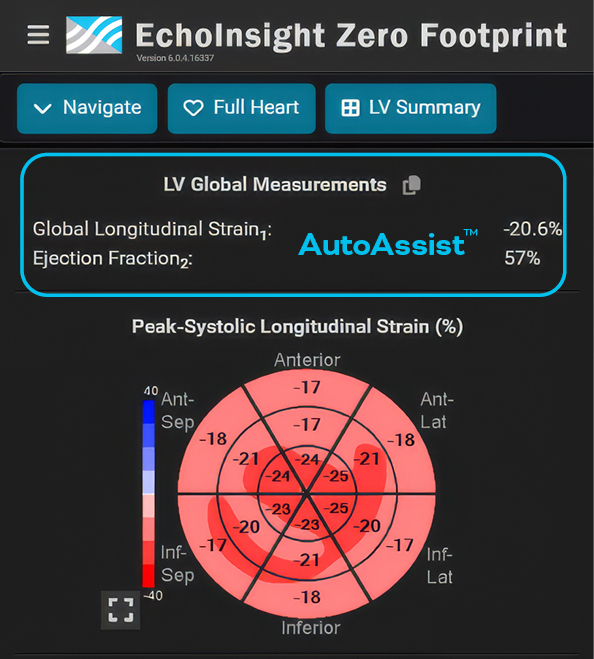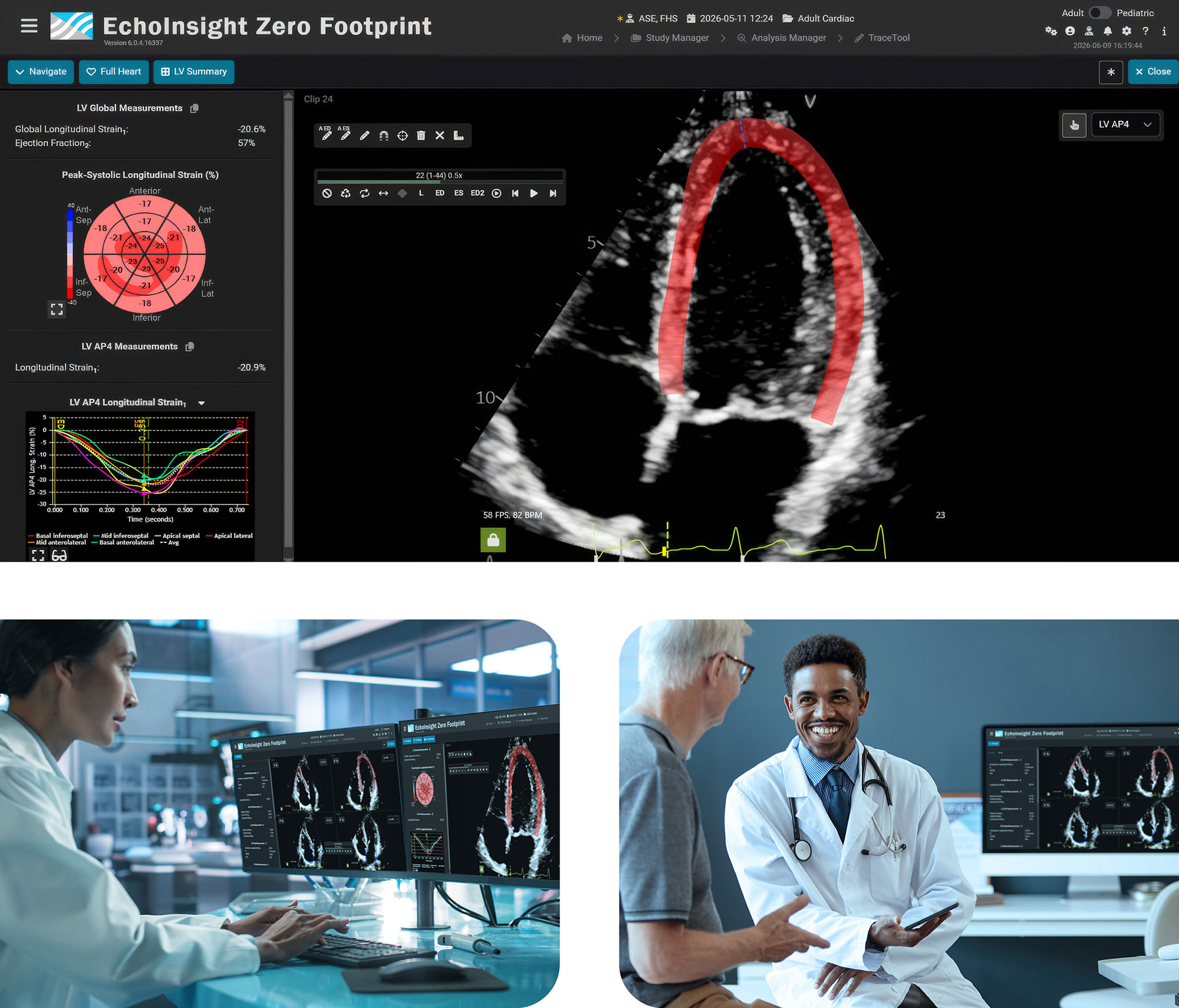
EchoInsight is built on echocardiographic speckle-tracking strain imaging, which tracks natural “speckles” in echocardiogram images frame by frame to measure how the heart muscle deforms as it beats. This method calculates myocardial strain—how much the muscle shortens, thickens, or stretches and can reveal subtle dysfunction before ejection fraction declines.
Speckle-tracking strain imaging is a key component of comprehensive echocardiographic assessment, helping clinicians detect cardiovascular dysfunction earlier, monitor disease progression, and make more informed decisions. In 2025, the American Society of Echocardiography published “Clinical Applications of Strain Echocardiography,” updated evidence-based guidance for using strain imaging in echocardiography. The guidelines identify reimbursable applications including heart failure, systolic and diastolic dysfunction, cardio-oncology, valvular and congenital heart disease, and RV and LA function. In the United States, myocardial strain imaging may be billed under CPT code 93356, an add-on code for speckle-tracking strain analysis with echo.
Introducing AutoAssist
 Epsilon Imaging’s proprietary approach to automation uses a hybrid of Artificial Intelligence (AI) deep learning with engineered algorithms to accomplish myocardial border-driven automatic region of interest placement. AutoAssist automates the echo view labelling task using deep learning classifier models, automatically classifying and organizing images by echo view, anatomy and pathology.
Epsilon Imaging’s proprietary approach to automation, AutoAssist, combines deep learning with shape and border detection software which enables AutoAssist to employ small to medium sized deep models, which permits a smaller training set while increasing performance for that same data. The technological benefit of AutoAssist Imaging versus pure, black-boxed deep learning-based automation is that it is not necessary to provide massive quantities of training data. Large models require large training sets which, in turn, require constant curation and expansion to achieve reasonable accuracy for different clinical indications (this includes genders, ethnicities, etc.). With AutoAssist, clinicians simply review and make any necessary edits, if needed, to finalize analysis.
AutoAssist provides:
- Fast analysis and auditing capabilities – automated echo view labeling and region of interest application for strain and cardiac function
- Increased standardization – myocardial region of interest always applied same way, every time.